History
Madeleine Herman started Volontariat in Pondicherry in 1962,
her aim was "to help first those who suffered the
most". (CF Madeleine’s portrait)
Oupalam
Madeleine’s programme was very ambitious, she wanted to:
- improve the health of this suffering population by curing many
diseases (tuberculosis, leprosy, cholera, intestinal worms,
infected sores, etc.)
- teach a few elementary principles of hygiene and nutrition to
the children and adults, especially the young mothers.
- reduce malnutrition of the youngest to allow proper brain
development.
- help adults find work and, if possible, regular jobs. 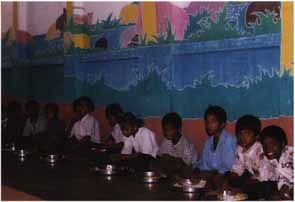
The necessity to create a structure for this organization
which was getting bigger lead Volontariat of Pondicherry to gain
legal recognition, by creating an Indian non-profit independant
and open to people of all religions association. That's how
Pandit Batt became the first president and was surrounded by a
board of directors.
The support of the Belgium organization enabled
Volontariat to expand its activities. Some actions are lead with
Indian organizations and the municipality which will result in a
few changes in their street:
- cleaner huts
- cleaner streets
- electricity
- a tap for drinking water
- a dustman’s job for some adults of Oupalam
The medicines sent by Europeans are used to take care of
more and more people who come from further and further away. Up
to 500 people come every afternoon to be taken care of, in a very
modest hut which has no electricity or running water.
This situation will last until 1968 when a European financing
will pay for the construction of the "community centre"
in the middle of the village. In this centre different activities
will take place:
- people’s dispensary, a room for consultations, a kitchen,
a room dedicated to the distribution of milk, which will become
later the nursery.
- a pre-school group and evening classes
- it will also be used as a shelter for the wet season and when
cyclones destroy the huts.
Volontariat spends a lot of time trying to convince the
parents that it is necessary to send their children to school.
They also try to reduce the problem of increasing demography in
India. A lot of energy is spent to create steady jobs and
resources for the families of Oupalam.
The doctors who look after the medical problems come from
the Jipmer hospital. In 1981 a new team decides to develop a
programme of preventive medicine. In 1982, a new centre opens:
the SELVANILAYAM centre where you can find a big cantine with the
kitchens, a library, a classroom for the evening classes, offices
etc... The community centre is reorganized to be more adapted for
the preventive medicine programme.
Volontariat is actively expanding its nursery,
kindergarten, evening classes. A special program of information
is put into place to make children aware of their lives'
conditions (illiteracy, bad employment, bad hygiene conditions,
bad nutrition, etc...) and to make sure that when they become
adults they will try to solve all those problems themselves.
The sponsorship programme is developed. The sponsored
children are followed by doctors and are sent to school, they are
given one meal every day. In some particularly bad cases they can
be sent to a pension in the region. But the biggest problem is to
find work for these youngsters once they have finished their
studies. That’s how Volontariat developed a few small
workshops used as training centres:
- a weaving workshop
- a cane workshop
- a workshop to manufacture ropes with coconut fibre.
In 1982, clubs are created (youth and women's clubs) which
start taking care of some of the community problems. All the
activities developed for the poorest have two goals: education
and employment.
The problem with the education programme is that even if
it takes care of hundreds of children, hundreds more ask to be
part of it and can’t be accepted because of the budget
limitations. 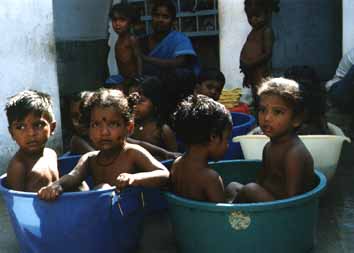
the SELVANILAYAM centre
The evening classes for the children take place there, they
are very important because they are the best way to make sure
that their homework is done. It's important because the children
are at the age were they are the most receptive to all the
principles they are taught, such as hygiene, prevention for some
diseases, and all the problems which concern their environment
(alcoholism, violence, debt, etc...) In 1991 all the classrooms
are completely packed, as well as the stair case, the kitchen and
the rest of the building. Volontariat decides to build a new
centre: the SHAKTI VIHAR centre which will be dedicated to
education. 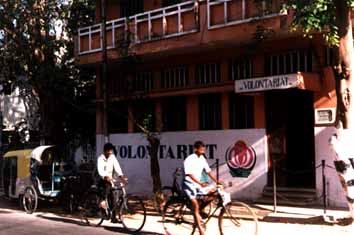
The most important daily activity is lunch for the
sponsored children. All lot of care is taken to make sure that
the meals are well balanced without breaking up with the
traditions. Other activities are organized for the children: a
youth club, music and yoga classes, and a library.
Search for and creation of employment still stays a
priority.
DUBRAYAPETH
Birth of the weaving workshop
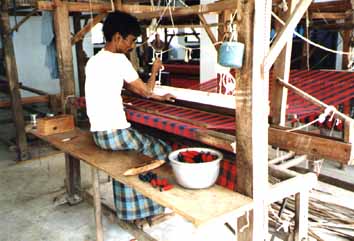
In 1965 a young leper, with an amputated leg, is sent by
Volontariat to a hospital for rehabilitation and to get an
artificial limb. When he gets back to Pondicherry his only option
is to go to the government-run Dubraypeth leprosy centre where
150 men and women — all, like him, completely cured but
handicapped and totally rejected by their families and the
society in general. The main activity of these people is to beg
for money to buy alcohol. This young leper doesn’t want to
become like the others so with the help of Madeleine and some
other voluntaries (including Madeleine’s husband Arnaud de
Blic) Volontariat offers him a weaver's job. That’s how, in
a bamboo cabin, a little workshop is opened just next to the
DUBRAYAPETH leprosy centre on the sea coast. The young leper
learns the trade with another person from the centre, later a
group of handicapped people follows him. The weaving looms are
manufactured by locals. The first products manufactured are
"longhis", men’s loincloths and tea towels.
They’re sold locally but there is too much competition so
very quickly the aim becomes to make products which can be sold
in Europe.
The lepers who had no hope found some work, they feel
respected again.
The weaving workshop
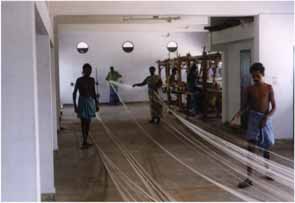
In 1977 a sowing section is added to the weaving workshop to
manufacture bags, patchworks and other articles. In 1981, the
workshop becomes an independent organization called the SHANTI
WORKSHOP. The workers are actively involved in the organization,
which develops solidarity amongst them. Thanks to Volontariat the
workers have advantages which are quite unusual in India: free
medicine, a low rent for their houses and electricity almost
free.
Development between 1982 and 1992.
The workers control their tools and are very proud to
export their products. In 1987 the workshop is too small and in a
bad state because of the wind and the rain of the wet season. So
an important repair and expand work programme is done to improve
the workshop by the way of a cofinancement europeen
and with also Emmaüs
International.
In 1991 a new three storey workshop is built improving
considerably working conditions. But after a cyclone and the
construction of a new port salted water endangers the building.
In 1992 protection work is done on the building.
TUTTIPAKKAM
The beginning of the farm
In the 1960's the poor countries decide to become
self-sufficient in food. That's how the green revolution started
in India. In 1966 Volontariat decided to participate to this
event, so they bought a piece of land which wasn't irrigated and
had alcalin soil where only filaos grew. It took a lot of time
and energy to make that piece of land flat and fertile.
Irrigation is now assured by two wells, resptively 120 and 160
metres deep. Rice, maize, vegetables, cotton and other products
are now cultivated on this land. The poor plots are used for the
cultivation of coconut trees and filaos. 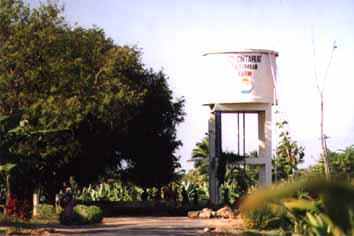 A plantation
of coconut trees, banana trees and other fruit trees should
enable the farm to be soon self-sufficient. All the products are
used for the children of Volontariat or sold at the local market.
A plantation
of coconut trees, banana trees and other fruit trees should
enable the farm to be soon self-sufficient. All the products are
used for the children of Volontariat or sold at the local market.
Development from 1972 to 1982:
A gift from Emmaüs finances
the construction of a new building used to store grain,
fertilisers and tools. Often some children from Oupalam come to
the farm for a visit or for holidays. Thanks to that farm some
families found a regular job.
A dry and desert piece of land became an oasis in 1967.
The production will soon be improved and many children enjoy
spending their holidays there.